Multi-Location Dental Group Software: What Changes at 5+ Locations (2026 DSO Guide)
How dental software needs change when you scale from a single practice to a multi-location group or DSO. Covers PMS consolidation, AI rollout, reporting, HIPAA-aware workflows, zero-retention, and the operational issues that only show up at scale.
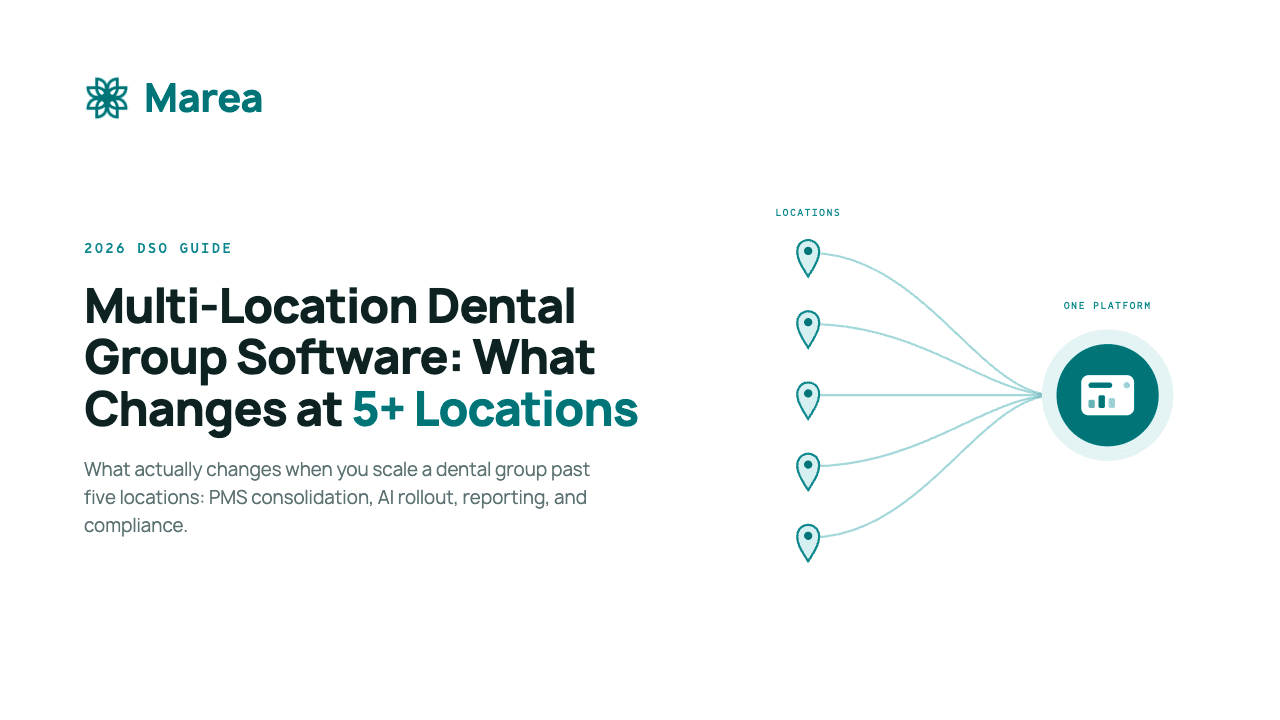
Single-location dental software is designed for a dentist running their own practice. Multi-location software is designed for an operator running a portfolio. The shift isn't just "more locations." It's a completely different set of problems: provider consistency across sites, centralized reporting, rollout coordination, patient-data handling, and the operational drag of running the same workflow five different ways. By 2026, the smartest dental groups have stopped trying to scale single-practice tools and are adopting platforms built for multi-location operations from the ground up, with clear HIPAA-aware workflows and zero-retention expectations where AI touches patient data.
Key Takeaways
- Most dental software is designed for a single practice and breaks in subtle but expensive ways when you have 5+ locations.
- DSOs and multi-location groups are increasingly common, but many still rely on tools originally designed for solo dentists.
- The biggest hidden cost of scale isn't software. It's the time spent reconciling data between locations that should already be connected.
- PMS consolidation is the single highest-leverage decision a multi-location group makes. Running three different PMS systems across six locations costs more in lost time than the PMS migration ever would.
- AI tools must be deployed centrally with location-level customization. A scribe that works beautifully in Location A but uses different templates in Location B creates workflow drift and review friction.
- The unit of value at scale is the platform, not the feature. A platform with PMS connectivity, centralized reporting, consistent configuration, and clean handoffs is worth more than four best-in-class point tools.
If you run two locations, you can hold the whole operation in your head. Same staff rotation, same handful of vendors, same provider habits. By the time you're at five locations, that mental model has broken down completely. The operational drag isn't from any single thing. It's from the dozen small inconsistencies between sites that compound every week.
This guide is for the operator who has crossed that threshold or is about to. Office managers, regional directors, DSO leadership, and practice owners running 3+ locations. We'll cover what actually changes when you scale, where most multi-location groups lose time, and what to look for in the software stack that supports a real portfolio.
We've written about the single-practice version of these problems in how to improve dental practice workflow and how dental practices lose 2+ hours a day. This piece is what changes when those problems multiply across locations.
The numbers at a glance
- 5+ — the point where software needs usually shift from single-practice tooling to group operations.
- Daily — the cadence groups eventually need for top location metrics, instead of manual monthly reconciliation.
- One layer — the practical goal: connect workflows above the PMS without forcing every location through a disruptive migration.
How Software Needs Evolve at Each Stage
The software stack that works at one location actively gets in the way at six. Here's how the needs shift as a group grows.
1 location: Local everything
A single PMS, one phone line, manual or paper forms, one front desk, one set of providers. The owner is in the operatory daily. Communication is in-person. Software choices are made based on what one dentist likes.
2 to 4 locations: The crack appears
Each location has its own version of the workflow. One uses Dentrix, the other Open Dental. One does paper intake, the other digital. Reporting requires logging into multiple systems and exporting CSVs into a spreadsheet. The owner is still hands-on but starting to delegate operations. This is the stage where most groups realize their software stack wasn't designed for them.
5 to 10 locations: Operations as a function
A regional or operations manager now exists as a role. Reporting becomes a weekly meeting. PMS consolidation is on the table or has already happened painfully. AI tools are being evaluated to reduce per-location admin load. The question is no longer "what tool is best" but "what platform supports the way we actually run."
10+ locations: DSO infrastructure
Centralized billing, centralized HR, and centralized vendor management become real operating functions. Software decisions are made by an operations or IT lead, not the dentists. HIPAA-aware workflows, data minimization, and dedicated account management start to matter.
Related read: How dental practices lose 2+ hours a day to admin work (and how to get it back).
The 7 Operational Issues That Only Appear at Scale
These don't exist when you have one location. By location five, they're eating into margin every single week.
01. Workflow drift between locations. Each location's team adjusts the workflow slightly to fit their own preferences. Six months later you have six versions of the same intake process, and onboarding a new provider means re-teaching them at each site.
02. PMS fragmentation. Different locations end up on different practice management systems, usually for historical reasons (one was an acquisition). Reporting requires manual consolidation. Cross-location appointment booking is functionally impossible.
03. Vendor sprawl. Each location signed its own contracts with answering services, form vendors, marketing tools, and review platforms. The group is paying separately for capabilities that could often be coordinated centrally.
04. Inconsistent provider documentation. Without a centralized scribe or template system, every dentist documents differently. Insurance claim narratives vary in quality. CDT code accuracy varies. Denials are higher in some locations than others, and nobody knows why.
05. Front-desk staffing arbitrage failure. The promise of multi-location is shared front-desk coverage. The reality is each location's calls still go to its own line, its own staff, and its own voicemail. After-hours calls are still missed everywhere.
06. Patient data retention uncertainty. At one location, it is easier to know where patient data goes. Across ten, every duplicate recording, copied note, exported file, and disconnected tool creates another place for patient information to sit. Groups should favor tools that are clear about what they keep, what they delete, and whether audio or full chart data is retained.
07. Reporting that requires a human. If "how did we do last month?" requires someone to manually export and reconcile data, you don't have reporting. You have a part-time analyst job that's invisibly costing the group thousands per month.
PMS Consolidation: One System or Many?
This is the highest-leverage decision a multi-location group makes. The answer is usually some flavor of "consolidate where possible, don't force it where it costs more than it saves."
Arguments for full consolidation
- One vendor relationship, one contract, one support channel
- Native cross-location reporting without spreadsheet gymnastics
- Standardized provider templates, fee schedules, and workflows
- Staff can rotate between locations without retraining on a new system
- Consistent operating record across locations
Arguments against forced consolidation
- Migration cost is real. A practice with 10 years of chart history in Dentrix doesn't move that easily to Open Dental.
- Some PMS systems are objectively better fit for certain specialties (TDO for endo, for example).
- Staff retraining costs in lost productivity during transition can run into the tens of thousands per location.
- Vendor lock-in is a real risk if you consolidate to a PMS that later raises prices or sells to private equity.
The pragmatic middle
For many multi-location groups, the pragmatic middle is not forced PMS consolidation. Instead, they look for a layer above the PMS that can support the workflows they want to standardize. The PMS at each location may stay the same while reporting, notes, phones, forms, and letters become more consistent. The key is to confirm the exact PMS integrations your locations need before rollout.
Related read: Best AI dental scribe (2026): full comparison of 8 tools by PMS integration depth.
Rolling Out AI Across Multiple Locations
AI rollout at a single practice is a one-week project. AI rollout across a multi-location group is an operations program. The difference matters because most AI vendors price and design their products for the former.
What multi-location AI rollout actually requires
Phased deployment. Pilot at one location, refine the workflow, then expand. Vendors that require all-locations-at-once are not built for portfolio operators.
Per-location customization with central control. Each location needs to be able to tweak templates, scheduling rules, and call scripts. But the group needs visibility and the ability to push standards across all sites.
Provider-level vs location-level configuration. A hygienist at one location should be able to inherit the group's hygiene template but customize for their own preferences. The system has to support both layers.
Training that scales. Per-location in-person training is expensive. The right vendor provides self-serve onboarding plus a dedicated implementation manager for the group, not per-location reps.
Reporting from day one. If you can't see adoption rates by location in week one, you can't course-correct. Centralized usage dashboards are non-negotiable.
What "enterprise-ready" actually means for dental AI
Not just a discount for more locations. It means: centralized rollout, per-location reporting, custom template inheritance, consistent settings, dedicated implementation, and a workflow model that keeps patient data moving without unnecessary copies. Ask for each of these specifically in any vendor evaluation.
Reporting, Visibility, and the "Single Pane of Glass" Problem
Every multi-location group eventually wants a single dashboard that shows every location's performance. Most spend years assembling it manually before realizing the right approach is to choose tools that report into one place by design.
What you actually need to see
- Calls answered, calls missed, and call-to-booking conversion by location
- Provider documentation time and scribe adoption by provider and location
- Treatment plan acceptance rate by location and provider
- Insurance claim denial rate by location
- New patient pipeline by source by location
- Cancellation and no-show rate by location with day-of-week breakdown
- Per-location P&L if you have the data
The 80/20 rule applies here. You don't need a perfect BI tool from day one. You need the top 3-4 metrics visible in one place, updated daily. Everything else is fine to assemble manually until you've outgrown spreadsheets.
HIPAA and Zero-Retention at Scale
A single practice has one set of patient-data workflows. A 10-location group has 10. The goal is to reduce the number of places patient information is copied, stored, or manually moved.
For dental AI, the key question is simple: what does the vendor retain after the workflow is complete? Favor zero-retention or minimal-retention designs where audio is not stored, the PMS chart is not replicated, and only necessary work products are kept for the practice to review, edit, export, or delete.
What to ask every dental AI vendor
- Does the product use a zero-retention or minimal-retention architecture for patient data?
- Is audio stored after a note, letter, form, or call workflow is complete?
- Does the vendor replicate the full PMS chart, or only use the minimum data needed for the workflow?
- Where are retained work products stored, and can the practice review, export, or delete them?
- How does the product support HIPAA-aware workflows across multiple locations?
- Can retention settings and workflow rules stay consistent across locations?
Related read: The shift to zero-retention: what dental software actually does with your patient data.
What to Look for in a Multi-Location Platform
The criteria below separate platforms built for groups from single-practice tools wearing an "enterprise" sticker. Use this when evaluating any dental platform for a multi-location group.
Read/write PMS integration with the systems your locations actually use. If you run 3 different PMSs across 6 locations, your platform needs to integrate with all 3. Confirm specific versions.
Centralized configuration with location-level overrides. Group sets the defaults. Each location can adjust within guardrails. Neither pure centralization nor pure local control works at scale.
Role clarity. Owner, regional manager, location manager, provider, hygienist, and front desk teams each need workflows and views that match their job without creating unnecessary clutter.
Native cross-location reporting. Built in, not assembled by your team. Updated automatically. Filterable by location, provider, date range, and metric.
Centralized billing model. One invoice and one renewal cycle are easier to manage than per-location subscriptions your team has to assemble into a spreadsheet.
Dedicated implementation and account management. A multi-location rollout cannot be self-serve. You need a real person who knows your group and helps with phased deployment.
Architecture that scales with you. A platform that worked at 5 locations should still work at 50. Ask the vendor about their largest deployment and what changed at that scale.
Why Multi-Location Groups Are Adopting Platforms in 2026
Groups usually reach a point where the cost of managing disconnected tools is no longer just a software cost. It becomes an operations cost: more training, more handoffs, more reporting cleanup, and more places patient data can be copied.
Marea was built with this operating reality in mind. The platform brings AI scribe, AI receptionist, smart forms, and referral letters into one workflow layer. For groups evaluating patient-data handling, the important Marea point is simple: the system is designed around zero retention, with audio not stored, the PMS chart not replicated, and retained work products available for the practice to review, edit, export, or delete.
Considering Marea for your group? Book a 30-minute call with our team. We'll walk through a multi-location deployment plan for a group your size, show how Marea handles scribe, receptionist, forms, and letters workflows, and answer patient-data questions around HIPAA and zero retention. Book a Free Demo.
Frequently Asked Questions
What size dental group should consider switching to a multi-location platform?
A good trigger is when leadership can no longer track performance, keep workflows consistent, or answer simple cross-location questions without manual cleanup. For many groups that happens around 4 to 5 locations, but the better test is operational complexity, not a fixed location count.
Do we have to migrate all our locations to the same PMS?
No. A practical approach is to keep locations on existing PMS software where migration would be disruptive, then standardize the workflow layer above it. The key is confirming integration details for your specific systems before rollout.
How do we handle HIPAA and zero-retention across multiple locations?
Start by mapping where patient data is created, copied, stored, and deleted in each workflow. Then ask vendors direct retention questions: is audio stored, is the PMS chart replicated, what work products are retained, and can the practice review, export, or delete them? For HIPAA-sensitive workflows, keep the process consistent across locations and avoid tools that create extra copies of patient data without a clear reason.
What's the typical rollout timeline for a dental AI platform across 5-10 locations?
Pilot at one location first. Use the pilot to refine templates, training, and location-specific rules. Then expand in waves rather than all at once. The exact timeline depends on location count, staff training, and how many workflows are being rolled out, but a staged rollout is usually safer than a big-bang deployment.
Can a single dental AI platform really reduce vendor sprawl?
It can reduce vendor sprawl when multiple workflows share the same system. Marea covers scribe, receptionist, forms, and letters, so groups can evaluate whether those pieces should live together instead of being handled by separate point tools. The value is not just fewer subscriptions; it is fewer handoffs and fewer places patient data gets copied.
What's the cost difference between platform consolidation and running multiple vendors?
The exact cost depends on products, locations, and usage. The cleaner comparison is total operating burden: how many systems the team logs into, how many invoices and renewal cycles they manage, and how much time is spent reconciling data. A consolidated platform may reduce that burden, but groups should model pricing against current vendor spend before making the switch.
How do we get buy-in from individual location managers who like their current tools?
Two principles. First, never force a tool change for its own sake. Identify the specific operational problem each location is having (missed calls, slow documentation, manual reporting) and frame the platform as the solution. Second, pilot in the most enthusiastic location first. Success stories from peer locations carry more weight than directives from the group office.
Sources & Further Reading
External sources
- American Dental Association: 2024 State of the Dental Industry Report
- DSO Industry Statistics: ADA Health Policy Institute
- HHS HIPAA guidance for health care providers
More from the Marea blog
Marea is the AI platform built for dental practices. Receptionist, scribe, letters, and forms layered onto the PMS you already use.